Showing posts with label Kelsey. Show all posts

Tuesday, November 29, 2011

Zebra Mussels


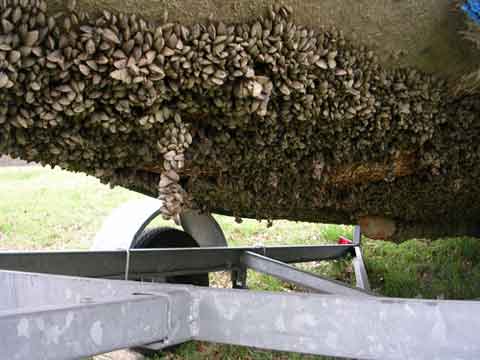
Although they may not seem like the most pertinent issue concerning the Hudson River, Zebra mussels are harmful to the river. They are native to the Black, Caspian, and Azov seas. From their initial appearance in America in 1988 in the Great Lakes, they spread to 28 states, and of course, the Hudson River. They arrived at the Great Lakes attached to a cargo ship traveling from the Black Sea. The larval forms of the mussels continued to attach to boats and travel across the country. I think they are a major problem, because like many other invasive species, they are not typically thought of as an environmental problem. However, they have major effects such as reducing the number of native mussels by anchoring on to them, preventing them from functioning. They also dwell in the pipes of power plants, public water supply plants, and industrial facilities, constricting the flow of water in and out. By attaching themselves to structures made of steel and concrete, they cause the structure to erode. Within the ecosystem, they significantly reduce phytoplankton, (by 85% in the Hudson), increasing transparency in the water. Although the water appears cleaner, it is not a beneficial thing because the food for other organisms has been reduced. Zebra mussels are not the first issue typically thought of when thinking about issues surrounding the Hudson River, however, they have already had a major impact, and continue to increase, killing more algae, invading more pipes, and taking the lives of native species.


Tuesday, November 15, 2011

Pioneer


The 102 foot long, 37 ton Pioneer was a sloop built in Pennsylvania in 1885, to carry sand to an iron foundry in Chester, Pennsylvania. In 1895, the sloop was turned into a schooner since it allowed for a smaller work crew. This ship is unlike most others because it has a wrought iron hull. It was made from iron, not wood, because it was made in the center or iron shipbuilding at the time. It is the first of 2 cargo ships ever made from iron and the only iron hulled merchant sailing vessel that still exists. In 1930 it was fitted with an engine and moved to Massachusetts. In 1966 Russel Grinnell renovated the ship by rebuilding the hull, and restoring the rig. After his death in 1970, it was sent to the Seaport Museum where it now remains, giving sailing tours daily. The engine is used to get it out of the River, but once there it uses only the sails, which reach up to 76.6 feet.


Tuesday, November 8, 2011

Prospect Park


Calvert Vaux and Frederick Law Olmstead worked together to establish Propsect Park. Vaux and Olmstead were introduced by Downing, when they all worked together to plan Central Park. Olmstead was a leading post civil war landscape architect, as well as a columnist for the New Yorker, helping him earn the position as Superintendent of Central Park. The area where Prospect park is located was the site of the first major battle of the revolutionary war. The Park's Drive was fortified by Washington during battle in 1776. The historical significance of the location relates the park to the great homes of the Hudson Valley because many are located near the sites of battles during the Revolutionary War as well. The desire to place a park in Brooklyn was not only for aesthetic and recreational purposes, but also to lure wealthy residents to the town. Like the many houses in the Hudson River Valley, it was a place to escape from the everyday chaos of city living. Olmstead believed that this was a necessity for everyone not just the wealthy. He believed that this park would provide escape for those who could not afford a second house. The construction of the park took place from July 1, 1865 until 1873. The initial plan included lengthy meadows, carriage drives with scenic outlook points, rich forests with various trees, rustic shelters, bridges, arches, a Concert Grove House and Pavilion for music, and a dairy with milking cows. One major section of the park, Long Meadow, was conceived as a space that felt more natural and less constructed area. However, to accomplish this, many trees were removed and transplanted, woods were thinned, dirt was moved, and a peat bog was filled in. This type of construction to establish a relaxed, stress free environment is similar to the gardens of the great houses that Downing designed. Overall a calm atmosphere was created through the strategic placement of trees and hills, like the gardens that Downing planned.

Wednesday, October 26, 2011

Spectra Pipeline Public Hearing


The Spectra Pipeline has been proposed to transmit natural gas into Connecticut, New Jersey, and New York. .7 miles of pipeline are projected to go through Manhattan both on land, near Greenwich Village, and under the Hudson in sections. Citizens of New York showed their frustration about this project at the FERC public hearing.  This hearing was the last one that would be held about the issue. The meeting was expected to run from seven to ten o clock, giving all of the speakers 2 minutes each to speak. The speeches were passionate and most were grounded in legitimate facts. It was amazing to see how much effort the speakers put in to attaining information and writing persuasive speeches for this hearing. The citizens were worried about the explosion of this pipe, since this has already happened in other places where the pipeline exists. With such an explosion, drinking water would be polluted and a highly populated area would be destroyed. Some tried to appeal to the company representatives’ personal life, bringing up the effect it would have on the family’s children, while others listed facts about previous issues with the pipelines which are likely to happen here. The use of natural gas was also an issue, as some pointed out, it is not a clean burning fuel. The solution that was often recommended was to use the money for the pipeline towards renewable energy sources instead, bringing about a greater change. 

Tuesday, October 11, 2011

Creation of the Palisades


jschumacher.typepad.com
Originally referred to as the Weehawken (rocks that look like rows of trees) by the Lenape, the cliffs that run along northeastern New Jersey and southern New York: the lower part of the Hudson River, have become known as the Palisades (fence of stakes). The cliffs are approximately 20 miles long and range from 300-540 feet high. They consist of marine originated items such as grains, fragments of fossils, and precipitates all made of calcium carbonate. These marine items were deposited in the ocean millions of years ago and were eventually lifted up to their position far above sea level. The Palisades were formed in the late early Jurassic Period around 186 million years ago during a plate shift where one plate went below the other pushing them up to 20,000 feet above sea level. In certain areas the mountains seems to stop but pick up again. These “tear faults” formed due to the subsidiary thrust faults that occurred after the initial occurrence. There is still evidence of the original landscape, changed by glaciers that moved through the lower Hudson River Valley, shown in the current path of the Hudson River. Long after their formation, in the middle of the 19th century, the Palisades were used for building materials, concrete aggregate and firewood. However in 1900 the New Jersey Federation of Women’s Clubs and the Palisades Interstate Park Commission formed and managed the land. In the 1930’s the Civilian Conservation Corp (CCC) and Works Progress Administration (WPA) built park trails which remain and are used today.  

Wednesday, October 5, 2011

Archaeological dig in Brooklyn


An archaeological dig began in 1999, in Brooklyn to uncover the remains of the Dutch Lott House. Due to asbestos within the house, excavations could only be made outside until the asbestos was removed. There are different eras associated with the house since more was added on from the original building. A garbage pit revealed a deposit of clam, oyster and conch shells with a coin from 1817 below it, showing that the deposit was made sometime after 1817. Many artifacts from the 1840s and 1860s were found in the trench such as bottles of opium, porcelain dolls, and ironstone which revealing the time period it was used during. It was believed that the house held African American slaves as well. Initially a plate was found marked with an X on the bottom, a typical characteristic of items owned by slaves to identify them. Once the crew moved inside the house they found a trap door that led to a small room without windows, which housed one of the Lotts’ slaves and was eventually used as part of the Underground Railroad. The evidence collected in addition to prior knowledge and pictures about the house, revealed that in the 1720s this home belonged to a Dutch family, and stayed in the family for the next 300 years during which it was transformed multiple times.


Archaeology.org

Sunday, October 2, 2011

The Sphere

Today I went to Battery Park, hoping to go to the Fresh Kills preview. While I was there I saw the Sphere, a sculpture by Fritz Koenig, that once stood near the World Trade Center and had been partially destroyed during the September 11th attacks. The sculpture was originally created to represent peace, and has since been placed in Battery Park with a constant flame in front to honor the victims. After seeing this, I thought about the attacks and what environmental consequences they had, particularly on the Hudson River.  With some research I found that a large amount of the debris from the site was shipped to Fresh Kills landfill.   Since this landfill had not been designed for toxic or hazardous material, which some of the World Trade Center debris contained, there was fear that it would leach into the surrounding waterways. Additionally, an immeasurable amount of airborne debris entered the water as well as contamination flowing in the run-off from fire hoses, washing the streets, and from rainstorms. Tests of the water showed high concentrations of dioxins, furans, PCBs, asbestos, mercury, and other metals. Although the amount of PCBs present was much higher than previous levels, the EPA determined that the effects of all factors on the water quality were very minimal. 


 Information from nrdc.org 

Wednesday, September 21, 2011

Striped Bass


While walking along the East River near Stuyvesant Cove I noticed a large fish in the water. I took a closer look and saw a large striped bass that had been disfigured. While striped bass are often introduced into many areas for recreational purposes the Hudson River is a breeding ground for them. This fish is native to the east river as well, yet I found it suspicious that such a large animal would be so mutilated. I am assuming that the fish came into contact with a boat since it doesn’t seem likely that there would be a larger animal in the east river that would attack it.

Tuesday, September 13, 2011

Water Quality in the East River


The waterway closest to me is the East River. Due to high levels of Phosphorous and Nitrogen in the water, caused by agricultural runoff and wastewater flowing into the river, there has been a loss in sea grass, increased levels of sediment, fish kills, along with many other ecological problems. However, with the institution of the 1972 Clean Water Act, the water quality of the East River has increased. Prior to the act the dissolved oxygen level in the water was very low, leading to the death of many species unable to survive with such little oxygen. However, the level of oxygen in the water is increasing, providing a more sustainable habitat for species. Additionally, there has been a decrease in fecal coliform in the water since dumping raw sewage into the river has been stopped. Despite these changes the species living in the East River are not typical. The presence of anchovy, striped bass, and Atlantic herring is unusual for this area since they are more commonly found in open coastal waters, yet they are in abundance in the east river. Researchers from the Hudson River Park predict that these organisms are present because the shoreline has been altered, destroying the typical habitat that supports creatures which normally dwell in estuary shorelines. Currently, plans are underway to develop a tidal power plant using the strong currents in the east river. The 30 turbines that will be placed in the water are predicted to have very little impact on the aquatic life and provide a more predictable alternative to wind or solar power.

Friday, September 9, 2011

Stuyvesant


In 1609, the area on 15th street between 1st and 2nd avenues looked very different. While there are still creatures roaming around, they are rats and cockroaches as opposed to the white-footed mice, beavers, wood ducks and red tailed hawks that were previously in abundance. These animals lived in the tulip tree forest growing on the stratified drift ground surface.   Although the Lenape most likely did not reside in this area, they used it for gathering the Mayapple, summer grape, and the oneseed burr cucumber. The nearest Lenape encampment was around 1700 meters away from here. It is intriguing to see what this area has become considering that around 400 years ago it was not considered very suitable for living.